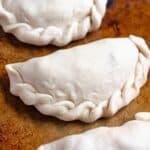
4 Ingredient Argentinian Empanada Dough
My beginner-friendly Empanada Dough is a simple hot water pastry dough that creates a soft yet sturdy crust perfect for savory or sweet fillings. This is a recipe I learned in Argentina, and it is buttery, easy to work with, and ideal for beginners who want homemade empanadas without complicated pastry techniques.
Servings 12 empanadas
Calories 192kcal
Ingredients
- 3¾ cup all-purpose flour
- 6 tbsp unsalted butter cut into cubes (cold)
- 1 cup + 2 tbsp boiling water (tip: Boil 3 cups of water, then carefully pour 1 cup + 2 tbsp of it into your mixing bowl)
- 1 tsp salt
Instructions
- In a medium mixing bowl, add the 1 cup + 2 tbsp boiling water (tip: Boil 3 cups of water, then carefully pour 1 cup + 2 tbsp of it into your mixing bowl) . Then add the 6 tbsp unsalted butter and 1 tsp salt into the boiling water and stir until the butter melts completely and the salt dissolves.
- Add 3¾ cup all-purpose flour into the bowl and use your hands to knead until the dough comes together in a shaggy but cohesive ball.
- Turn the dough out onto a floured countertop and continue to knead for about 5 minutes, until you have a smooth, soft dough that is not sticky (if your dough is sticky, knead another 1 tablespoon of flour into it at a time).
- Wrap the dough in cling wrap and allow it to rest at room temperature for at least 2 hours.
- Form the empanada dough into portions the size of golf balls. Roll each ball out into a thin disk.
- Place about 1 heaping tbsp of filling in the center of the dough ball. Fold one half of the dough over and pinch the edges together to hold the empanada together. Crimp the edges shut tight with a fork. For a fancier finish, pinch and twist little portions of the edge down to form a braided appearance.
Video
Notes
Recipe from Vicky's Cooking Class in Buenos Aires. I highly recommend it! For educational or personal use only.
- Unsalted Butter: If you substitute shortening, the dough may become sturdier but less flavorful.
- Be careful when mixing the dough at first since the water is very hot. Using a spoon initially helps prevent burns.
- If the dough feels sticky while kneading, add flour gradually, one tablespoon at a time, until it becomes smooth but still soft.
- Resting the dough is important because it allows the gluten to relax, making the dough easier to roll out without shrinking back. You’ll know the dough is ready to roll when you can tear off a small portion of the dough and the dough stretches!
- Roll the dough evenly so the empanadas cook consistently and do not become too thick around the edges.
- Make sure to seal the edges tightly and avoid over filling to prevent filling from leaking during baking or frying.
Nutrition
Serving: 1g | Calories: 192kcal | Carbohydrates: 30g | Protein: 4g | Fat: 6g | Saturated Fat: 4g | Polyunsaturated Fat: 0.4g | Monounsaturated Fat: 2g | Trans Fat: 0.2g | Cholesterol: 15mg | Sodium: 195mg | Potassium: 44mg | Fiber: 1g | Sugar: 0.1g | Vitamin A: 175IU | Calcium: 8mg | Iron: 2mg